
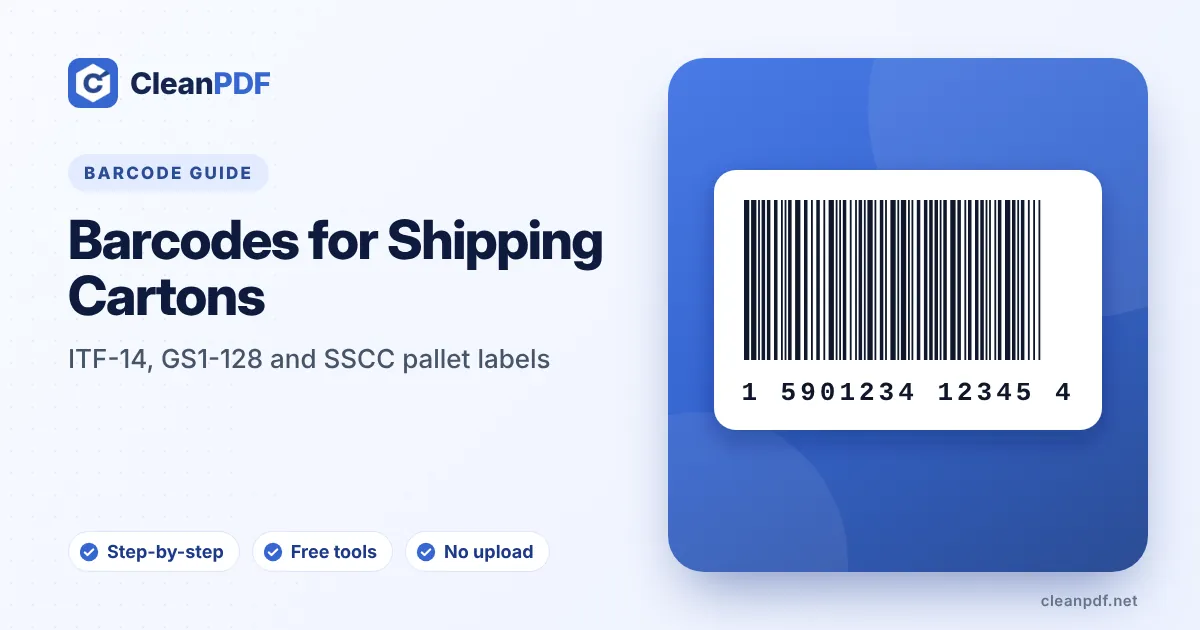
The product inside has its own EAN-13 or UPC. The outer carton gets a 14-digit GTIN, usually printed as an ITF-14 barcode directly on the cardboard. When you also need batch numbers, expiry dates or weights, use a GS1-128 label, which carries several fields marked with application identifiers like (01) GTIN, (10) batch and (17) expiry. Each pallet or shipment gets an SSCC, a unique 18-digit number printed in GS1-128.
Retail barcodes are about the single item a shopper picks up. Warehouses deal in cartons and pallets, and those need their own numbers. Receiving teams scan a carton once to book in 24 bottles, not 24 times. The codes are all part of the same GS1 system, so they work together if you set them up in the right order.
Three levels, three codes
| Level | Number | Usual barcode | Scanned at |
|---|---|---|---|
| Single item | GTIN-13 (or GTIN-12) | EAN-13 / UPC-A | Shop checkout |
| Carton or case | GTIN-14 | ITF-14, or GS1-128 with (01) | Warehouse receiving and picking |
| Pallet or shipment | SSCC (18 digits) | GS1-128 with (00) | Dispatch, transport, goods-in |
ITF-14 and the indicator digit
A carton of 12 bottles is a different trade item from one bottle, so it needs its own number. Instead of inventing a new one, GS1 lets you build it from the bottle’s number:
- Start with the item’s GTIN-13
For example 5 901234 12345 7.
- Drop the check digit
Leaving 590123412345.
- Add an indicator digit (1 to 8) in front
1 for the carton of 12, 2 for a carton of 24, and so on.
- Calculate a new check digit
The ITF-14 generator adds it automatically.
Each pack size gets a different indicator digit, so the warehouse system knows exactly what’s inside without opening the box.
Why ITF-14 has a thick frame
ITF-14 is designed to be printed directly onto brown corrugated board, often by simple printers at the packing line. The thick black frame around it, called a bearer bar, stops the printing plate from smearing the edges and prevents a scanner from reading only part of the code. Keep the full frame when you print on cardboard. On white labels, a top and bottom bar is enough.
GS1-128: one barcode, many fields
GS1-128 is based on Code 128 but adds application identifiers (AIs): short numbers in brackets that say what the next piece of data means.
| AI | Meaning | Example |
|---|---|---|
| (00) | SSCC, the pallet or parcel ID | (00)359012340000000018 |
| (01) | GTIN of the item or carton | (01)15901234123454 |
| (02) | GTIN of the contents, used with (37) | (02)05901234123457 |
| (10) | Batch or lot number | (10)LOT2611A |
| (17) | Expiry date, YYMMDD | (17)280531 |
| (15) | Best before date, YYMMDD | (15)270930 |
| (37) | Number of items | (37)48 |
The brackets are only printed in the human-readable text. In the barcode itself, special FNC1 characters separate the fields. That’s why you should build GS1-128 with a proper generator rather than typing brackets into a plain Code 128 tool; the result might look right but scanners won’t split the data correctly.
SSCC pallet labels
Every pallet or parcel you dispatch gets a unique SSCC: your GS1 company prefix, a serial number you never reuse, and a check digit. The logistics label shows it as a large GS1-128 barcode, usually at the bottom, with shipment details above. The buyer’s system scans one barcode and knows the whole contents of the pallet, provided you’ve sent the details electronically. Large retailers publish their own label layouts; ask for theirs before you print.
Printing tips for cartons
- Place codes on at least two adjacent sides so they can be scanned however the carton is stacked.
- Keep them away from edges, folds and tape, and at least about 32 mm up from the bottom.
- Download vector files (PDF or SVG) for the printer, never a resized screenshot.
- Test with a real warehouse scanner from a metre away before a full print run.
Product numbers themselves come from GS1, as explained in how to get barcodes for products.
Frequently asked questions
What barcode goes on a shipping carton?
What is the indicator digit in ITF-14?
What is the difference between GS1-128 and Code 128?
What is an SSCC?
Can I use the same barcode on the product and the carton?
Create an ITF-14 carton barcode
Enter 13 digits and the check digit is added. Bearer bars and vector download included.
Open ITF-14 Generator