
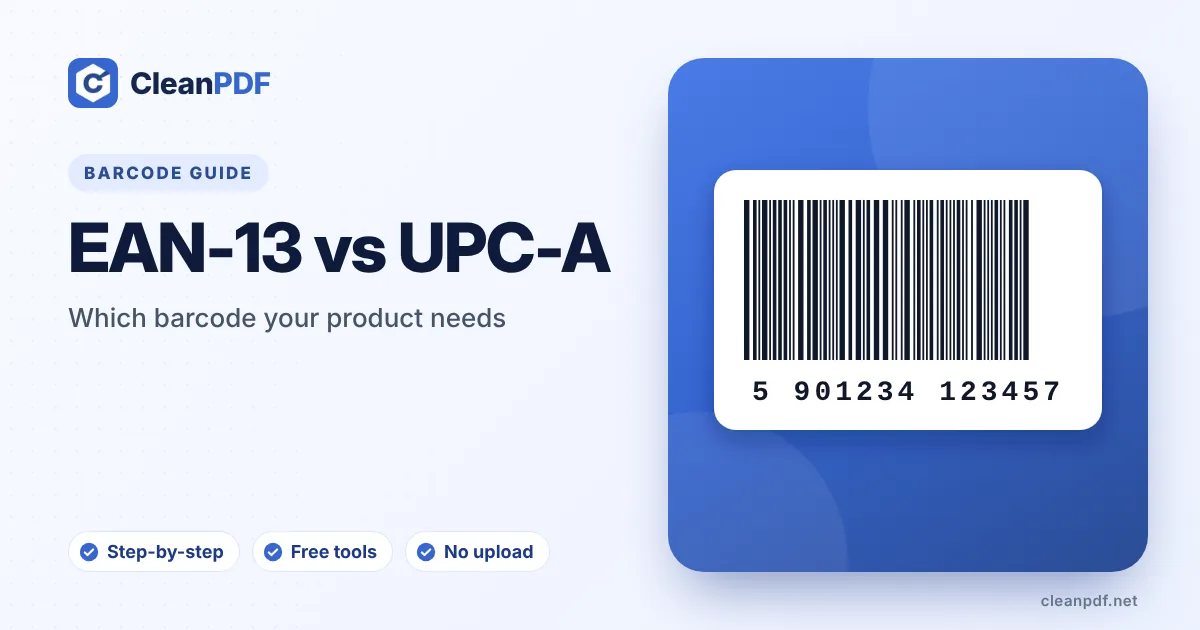
UPC-A (12 digits) is used mainly in the USA and Canada; EAN-13 (13 digits) is used almost everywhere else. They’re part of the same GS1 system: a UPC-A is simply an EAN-13 that starts with 0, and checkout scanners in North America have read EAN-13 since 2005. Print the format that matches the number GS1 gave you: a 12-digit GTIN as UPC-A, a 13-digit GTIN as EAN-13.
You’re about to print packaging, and someone asks: “Do you need EAN or UPC?” A marketplace form wants one, a distributor mentions the other, and the barcode supplier sells both.
Here’s the short version: they are two ways of writing the same kind of number, and you rarely get to choose. The number you were given decides it.
One system, two formats
Both barcodes carry a GTIN, a Global Trade Item Number issued through GS1, the organisation that runs retail barcodes worldwide.
- UPC-A encodes a 12-digit GTIN-12. It started in the USA in the 1970s and is still standard in the USA and Canada.
- EAN-13 encodes a 13-digit GTIN-13. It was created in Europe as an extension of UPC and became the standard almost everywhere else, including Pakistan, India, the UK, the EU and the Gulf.
The key detail: a UPC-A is an EAN-13 with a leading zero. The UPC 036000291452 is the EAN 0036000291452. Same product, same bars in the middle.
Side by side
| UPC-A | EAN-13 | |
|---|---|---|
| Digits | 12 | 13 |
| Number type | GTIN-12 | GTIN-13 |
| Main region | USA and Canada | Rest of the world |
| Scanned in US shops? | Yes | Yes, since 2005 |
| Scanned outside North America? | Yes | Yes |
| Small-pack version | UPC-E (8 digits, zero-suppressed) | EAN-8 |
| Books | – | ISBN-13 as “Bookland” EAN-13 |
North American retailers agreed to scan EAN-13 from 1 January 2005, a deadline known as Sunrise 2005. Since then, an EAN-13 on a product sold in the USA scans fine at the till. In the other direction, UPC-A codes have always scanned in the rest of the world.
What the digits mean
Take the EAN-13 5 901234 12345 7:
- Prefix (590): the GS1 member organisation that issued the company number. 890 is GS1 India, 896 is GS1 Pakistan, 50 is GS1 UK. It shows where the number was issued, not where the product was made.
- Company and item number: your company prefix, then a number you assign to each product and size.
- Check digit (7): calculated from the other twelve so scanners can catch misreads.
The barcode doesn’t contain a price or product name. The shop’s system looks the number up in its own database.
How the check digit works
For EAN-13, multiply the first 12 digits alternately by 1 and 3 starting from the left, add the results, and take the amount needed to reach the next multiple of 10.
For 590123412345: 5×1 + 9×3 + 0×1 + 1×3 + 2×1 + 3×3 + 4×1 + 1×3 + 2×1 + 3×3 + 4×1 + 5×3 = 83. The next multiple of 10 is 90, so the check digit is 7.
UPC-A works the same way with the weights starting at 3 instead of 1, which is exactly what you’d expect once you remember the hidden leading zero. Our EAN-13 and UPC-A generators add the check digit for you.
Which one should you print?
- Look at the number you were issued.
GS1 US and GS1 Canada usually issue 12-digit numbers: print UPC-A. Other GS1 offices issue 13-digit numbers: print EAN-13.
- Selling only in North America with a 13-digit number?
Print the EAN-13. It has scanned in US and Canadian stores since 2005.
- A retailer insists on UPC?
Ask what they actually check. Most systems store all GTINs as 14 digits internally and don’t care. If they really require a 12-digit number, you’ll need one issued by GS1 US.
Printing size
At 100% magnification an EAN-13 is about 37.3 × 25.9 mm including the quiet zones, with a narrow bar (X-dimension) of 0.33 mm. GS1 allows scaling between 80% and 200%. Keep the white space on both sides, print dark bars on a light background and don’t cut the height down too much; truncated barcodes are a common reason for scanning problems at the till.
Getting a real number
The barcode is the easy part. The number is what matters, and for retail it must come from GS1. Our guide on how to get barcodes for your products explains the options and the risk of cheap resold numbers.
Frequently asked questions
Is EAN-13 the same as UPC-A?
Can I use an EAN-13 barcode in the USA?
Does the first digit of an EAN-13 show the country of origin?
Can I convert a UPC-A to EAN-13?
What is the check digit?
Make your EAN-13 or UPC-A barcode
Check digit added automatically, correct size, PNG, SVG or vector PDF. Drawn in your browser.
Create an EAN-13 Barcode