
Use EAN-13 or UPC-A for products sold in shops, ITF-14 for outer cartons, GS1-128 for pallets and logistics labels with batch or expiry data, Code 128 for your own stock, asset and shipping labels, QR codes for links customers scan with phones, Data Matrix for tiny parts and medicine packs, and PDF417 or Aztec for IDs and tickets.
Most barcode guides read like a dictionary: forty types in alphabetical order. That’s not how anyone chooses. You start from the job, such as “I sell jars of honey” or “I need to label 300 laptops”, and the right barcode almost picks itself.
Linear (1D) vs 2D in one minute
- Linear barcodes are the classic black lines. They hold a short number or code, read left to right, and work with cheap laser scanners.
- 2D barcodes (QR, Data Matrix, PDF417, Aztec) store data in a grid. They hold much more in less space, survive some damage and can be read by phone cameras, but need camera-based scanners.
Which barcode for which job
| Job | Barcode | Why |
|---|---|---|
| Product sold in shops | EAN-13 / UPC-A | Every retail checkout reads them; carry a GS1 GTIN |
| Very small product packs | EAN-8 / UPC-E | Compact versions for lipsticks, gum and small items |
| Outer cartons and cases | ITF-14 | Prints well on brown corrugated board |
| Pallets, batch and expiry labels | GS1-128 | Holds GTIN, batch, expiry and serial numbers in one code |
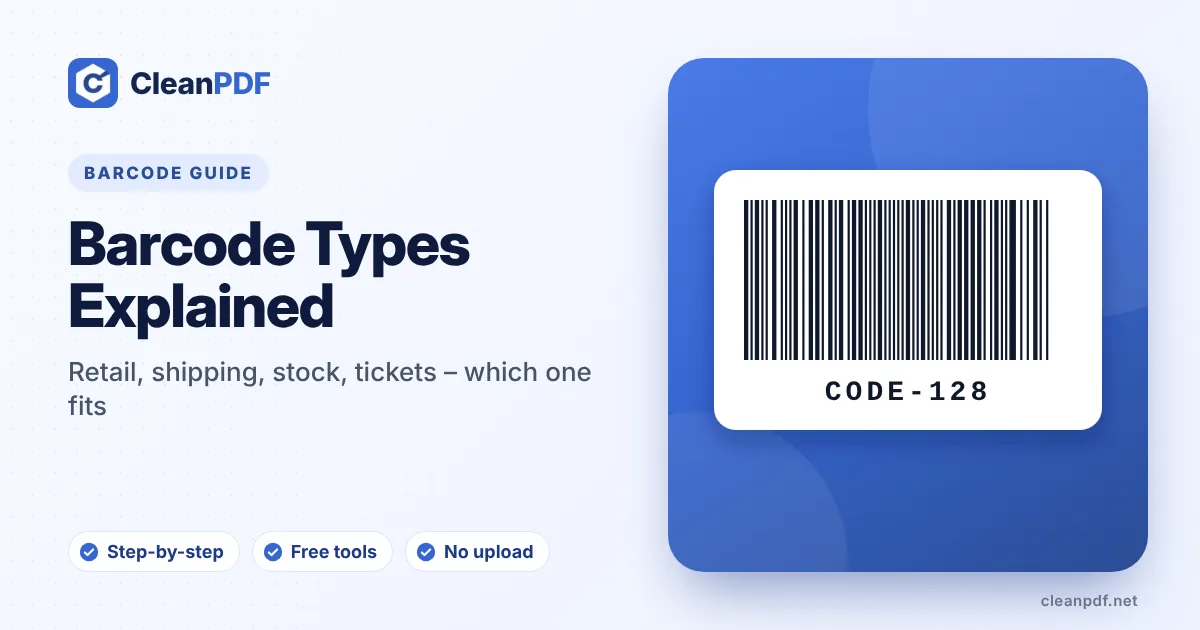
| Your own stock, assets, shipping | Code 128 | Letters and numbers, compact, read by almost all scanners |
| Older industrial or government systems | Code 39 | Simple and widely supported, but wide |
| Books and magazines | ISBN / ISSN | EAN-13 built from the ISBN or ISSN |
| Links, menus, payments for phones | QR code | Every phone camera reads it |
| Tiny parts, medicines, electronics | Data Matrix | Lots of data in a few millimetres |
| ID cards, driving licences | PDF417 | Holds a lot of text on a wide, short strip |
| Train and airline tickets on phones | Aztec, PDF417 or QR | Reads well from screens, needs no quiet zone (Aztec) |
| Fresh produce, coupons | GS1 DataBar | Small, can carry weight and expiry |
| Libraries, blood banks (legacy) | Codabar | Old and simple, still in older systems |
Retail barcodes: EAN and UPC
These carry a GTIN, a number registered to your company through GS1. Their whole value comes from that registration; the bars only carry the number. If you sell through shops or marketplaces, this is the barcode you need. Our guide to EAN-13 vs UPC-A explains which of the two, and how to get barcodes for your products covers the numbers.
Code 128: the workhorse for internal labels
For anything that stays inside your business, like warehouse bins, asset tags, job cards, document tracking and shipping references, Code 128 is usually the best choice. It encodes letters, numbers and symbols, is compact, and every modern scanner reads it. You don’t need GS1 for internal codes; you just need a numbering scheme that won’t repeat.
Code 128 or Code 39?
Code 39 is older and simpler, and some systems still require it. But it only supports capital letters, digits and a few symbols, and the same data takes up much more space than Code 128. Unless your software asks for Code 39 specifically, pick Code 128.
GS1-128: logistics with extra data
GS1-128 is Code 128 with a set of standard rules. Data is split into fields called Application Identifiers, written in brackets: (01) for the GTIN, (10) for the batch or lot, (17) for the expiry date, (00) for the shipping container’s serial code. Large retailers and distributors often require GS1-128 labels on pallets and cases.
2D codes: QR, Data Matrix, PDF417, Aztec
- QR code: made for phones. Use it for anything a customer scans: websites, menus, Wi-Fi, payments. See our guides on static vs dynamic codes and QR code print sizes.
- Data Matrix: the industrial cousin. Smaller than a QR code for the same data, common on electronic parts, surgical instruments and medicine packs (as GS1 DataMatrix).
- PDF417: a stacked barcode found on many ID cards and driving licences, and on some boarding passes.
- Aztec: used for many mobile train and airline tickets; it reads well from a phone screen.
Questions to ask before you choose
- Who will scan it?
Customers with phones: QR. Shop tills: EAN/UPC. Your own warehouse scanners: check what they read, then usually Code 128.
- Does someone else require a format?
Retailers, couriers and regulators often specify one. Their spec wins.
- How much space is there?
Tiny parts need Data Matrix; cartons can take ITF-14.
- How much data?
Just an ID: linear barcode. A link, batch and expiry, or a whole address: 2D.
Frequently asked questions
What is the most common barcode type?
What is the difference between Code 128 and Code 39?
Can a phone scan normal barcodes?
Do I need GS1 for a Code 128 barcode?
Which barcode holds the most data?
Create any barcode type
EAN, UPC, Code 128, GS1-128, Data Matrix, PDF417 and more, drawn in your browser.
Open Barcode Generator