
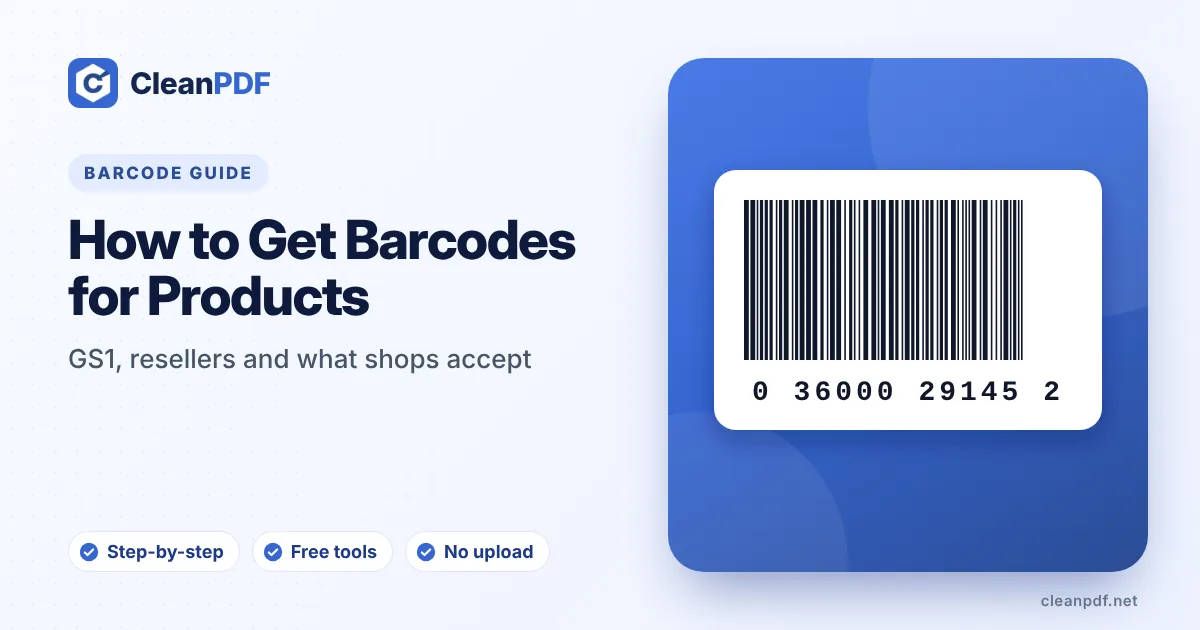
Retail barcodes need a registered number (a GTIN) from GS1, either through your country’s GS1 office (GS1 Pakistan, GS1 India, GS1 UK and so on) or, in the USA, as single GTINs from GS1 US. You join, receive a company prefix, assign a number to each product, then draw the barcodes with any generator. Cheap numbers from resellers are often recycled and get rejected by Amazon and large retailers.
A barcode generator draws bars from any number you type. That’s the easy part. The hard question is which number, because a supermarket, wholesaler or marketplace doesn’t just scan the bars; it checks whether the number is genuinely yours.
GS1: who hands out the numbers
GS1 is a non-profit organisation that runs the retail barcode system worldwide through national member organisations: GS1 Pakistan, GS1 India, GS1 UK, GS1 US, GS1 UAE and more than a hundred others. When you join, you receive a company prefix: the first part of every number you’ll use. You add your own item numbers after it, and the result is a GTIN for each product.
The GTIN is registered to your company. That’s what retailers and marketplaces check.
Your options
| Option | Good for | Watch out for |
|---|---|---|
| GS1 membership in your country | Brands planning several products and retail distribution | Joining fee plus an annual fee, which varies by country and the number of products |
| Single GTINs (GS1 US) | A handful of products sold in the USA | Around US$30 per number with no renewal fee at the time of writing; not a company prefix |
| Numbers from resellers | Rarely a good idea | Often recycled numbers registered to another company; rejected by many retailers and marketplaces |
| In-store codes (prefix 20–29) | Your own shop only | Not valid outside your own store |
Fees change and differ from country to country, so check your national GS1 office’s current price list before budgeting.
Why cheap barcodes get rejected
Before the year 2002, GS1 US (then the Uniform Code Council) sold company prefixes without annual fees. Some of those old prefixes were later split up and resold in small batches. The numbers scan perfectly. But when a retailer looks them up in GS1’s database, they show another company’s name, or no product at all.
Amazon checks product IDs against the GS1 database, and large retail chains increasingly do the same. If your listing is blocked or a buyer asks for a GS1 certificate, a resold number won’t help.
How many numbers do you need?
One GTIN for every version of a product that’s sold or stocked separately:
- Each size: 250 g and 500 g are different products.
- Each flavour, colour or variant.
- Each multipack sold as one unit, such as a pack of 6.
- Cartons for wholesale need their own number too, often printed as an ITF-14 on the outer box.
Price changes don’t need a new number. A significant change to the product itself, such as a new net weight, usually does.
Generating the barcode
- Pick the format.
For a 13-digit number, use EAN-13; for a 12-digit US number, UPC-A. Not sure? See EAN-13 vs UPC-A.
- Enter the first 12 (or 11) digits.
The check digit is calculated automatically. If you type all 13 and the last one doesn’t match, the number has a typo.
- Download a vector file.
SVG or PDF gives your packaging printer sharp bars at any size.
Printing it right
- Black bars on white or a light background. Red bars don’t scan, because many scanners use red light.
- Keep it at 80–200% of the nominal size (100% is about 37 × 26 mm for EAN-13).
- Don’t cut the height or the white margins on either side.
- Avoid curved edges, seams and folds.
- Scan a printed proof with a barcode reader before the full run.
What about 2D barcodes?
GS1 is working with retailers on Sunrise 2027, a target for checkout systems to scan 2D barcodes (such as QR codes carrying GS1 data) by the end of 2027. 2D codes can hold batch numbers, expiry dates and a web link alongside the GTIN. For now, they appear next to the familiar EAN or UPC rather than replacing it, so a standard linear barcode is still what you need on pack today.
Books are different
Books use an ISBN, issued by your national ISBN agency rather than GS1, and printed as a special EAN-13. See ISBN barcodes for self-published books.
Frequently asked questions
Do I need GS1 to get a barcode?
Can I make my own barcode number?
Are cheap barcodes from resellers legal?
Does each product size need a different barcode?
Do I need a new barcode if I change the price?
Turn your GTIN into a print-ready barcode
EAN-13, UPC-A, ITF-14 and more, with check digits added and vector downloads.
Open Barcode Generator